
Continuing from Part 1 (read here if you missed it), we are now on Day 3 of the Ladakh Trip.
Day 3: Local sightseeing @ Leh
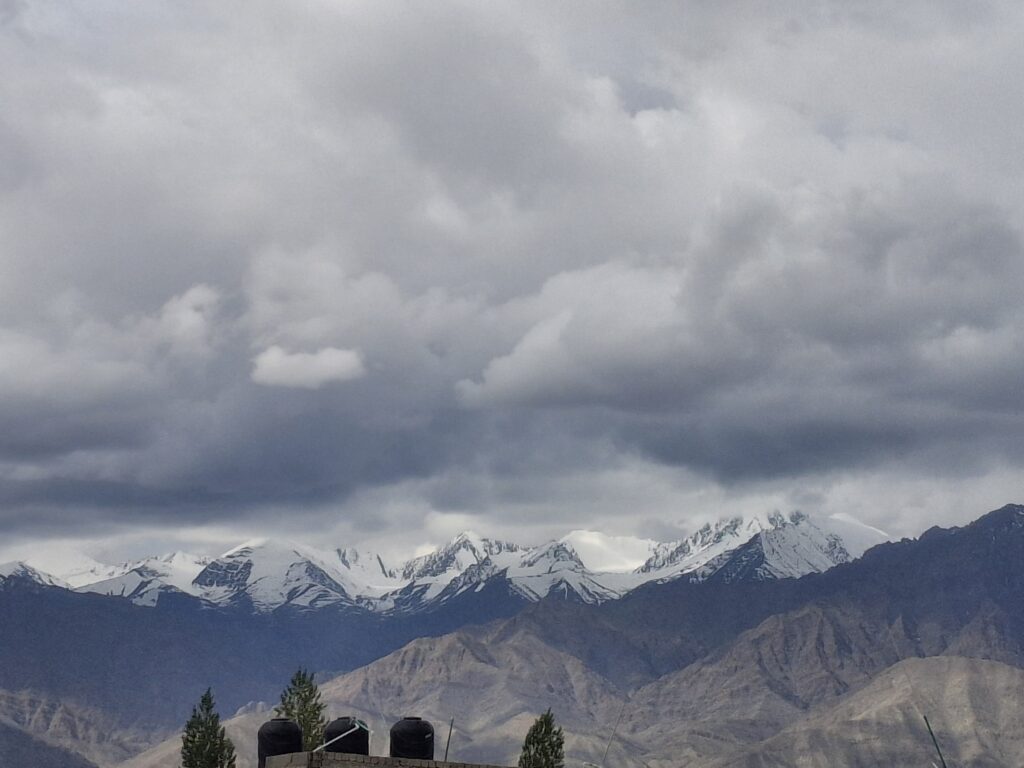
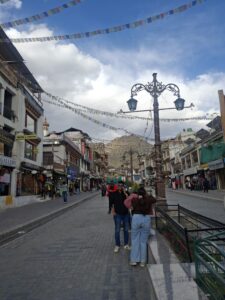
Leh is a town encircled by mountains on all sides, in all shapes, sizes, and hues. Wherever you stand in Leh and look around, you will get to see the mountains! The streets are narrow, with gentle ups, downs, and curves. Amid a peak traffic season, the small, idyllic town was nevertheless buzzing with tourists and tourist cars. Traffic within the town, therefore, moves slowly, navigating narrow lanes with parked cars on the sides. This year, in just May, tourist footfall was almost double that of last year. I guess the war in the Gulf made many Indians look inward for summer vacation options, and, not surprisingly, Ladakh emerged as a top choice. The pleasant summer weather in Leh provides a welcome escape from the scorching heat in most cities in India. The town is neat, clean, and well organised, with the administration putting in considerable effort to keep the place clutter-free.
Leh, a strategic border town for India, has a visible military presence. Ladakh borders both Pakistan (across the Line of Control) and China (across the Line of Actual Control), making it a strategically significant region from a national security perspective. You cannot miss the sight of Army cantonments, military base camps, convoys of military vehicles, and vantage points manned by the Indian Army. The Leh airport is small and basic and adjoins the military airbase. It is named after Kushok Bakula Rinpoche, a revered Buddhist spiritual leader, statesman, and diplomat from Ladakh who played an important role in promoting Buddhism, education, and the region’s development. A new terminal is under construction and is expected to be operational very soon. This is the need of the hour, given the exponential increase in tourist inflows in the last few years.
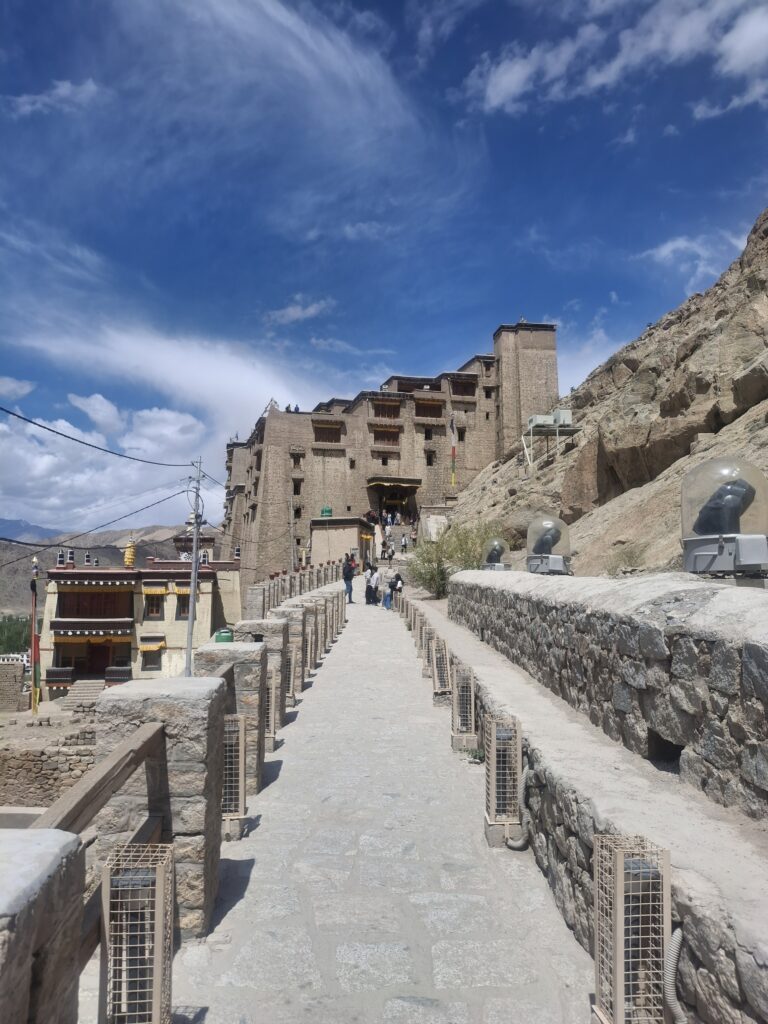
Our first stop of the day was Leh Palace (locally known as Lhachan Palkhar), from whose top you get a panoramic view of the entire town of Leh. The erstwhile royal palace has nine levels, which you can climb one by one through narrow steps. The rooms on these levels, meant for different purpose, have been painstakingly restored and preserved for their ancient woodwork. The restoration work was initiated in 1998, I believe, and has been carried out in phases. Even now, we could see artisans and carpenters at work in some of the rooms of the palace. The palace was constructed by Senge Namgyal, a 17th-century king of the Namgyal dynasty. The Namgyals occupied this place until the time of the Dogra invasion (1834-40).
Our next stop was the Sangam point, about 40 km from Leh town. This is the confluence of the Indus and the Zanskar rivers. What is fascinating is that at this point you can clearly identify both rivers thanks to their distinct colour of the water – the emerald-green of the Indus and the muddy yellow/brown of the Zanskar. You can first take a panoramic view of this Sangam point from the highway viewpoint, then descend to the banks for a closer look. The point naturally boasts fabulous views of the surrounding mountains and is a must-see for tourists.
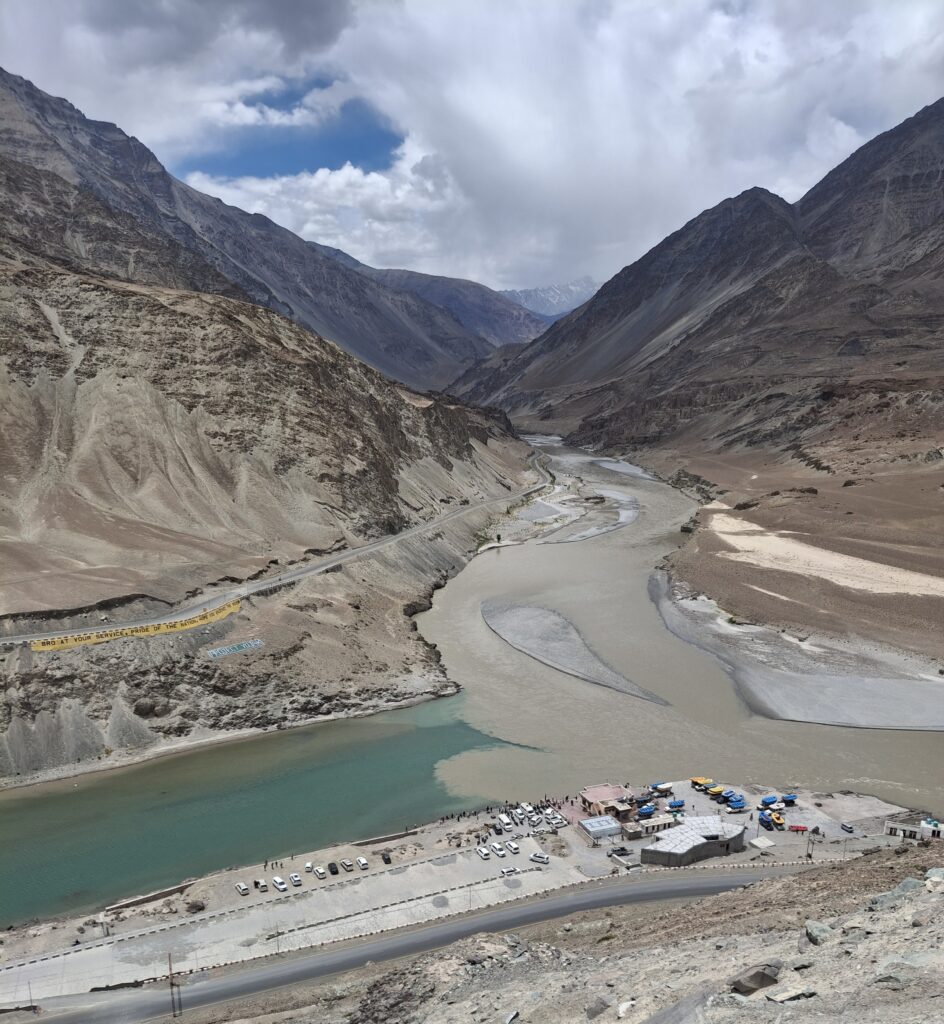
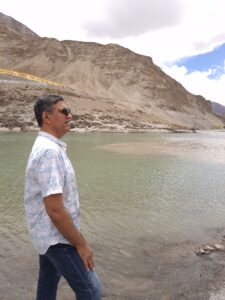
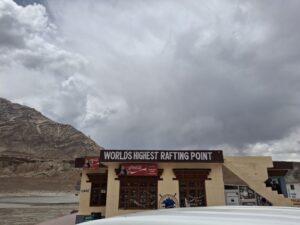
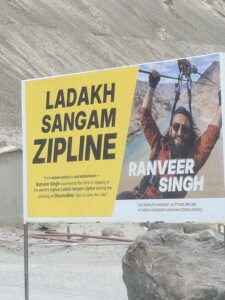
In addition, the administration has done well in developing this into an activity centre with rafting, ziplining, etc. In fact, the Zipline at this point is touted as “the world’s highest altitude Zipline”. This point has gained added heft thanks to Ranveer Singh, who experienced the Zipline here while shooting Dhurandhar. Incidentally, many of the Afghan portions in Dhurandhar were shot in Leh. There is another interesting reference to Dhurandhar, which we will talk about later.
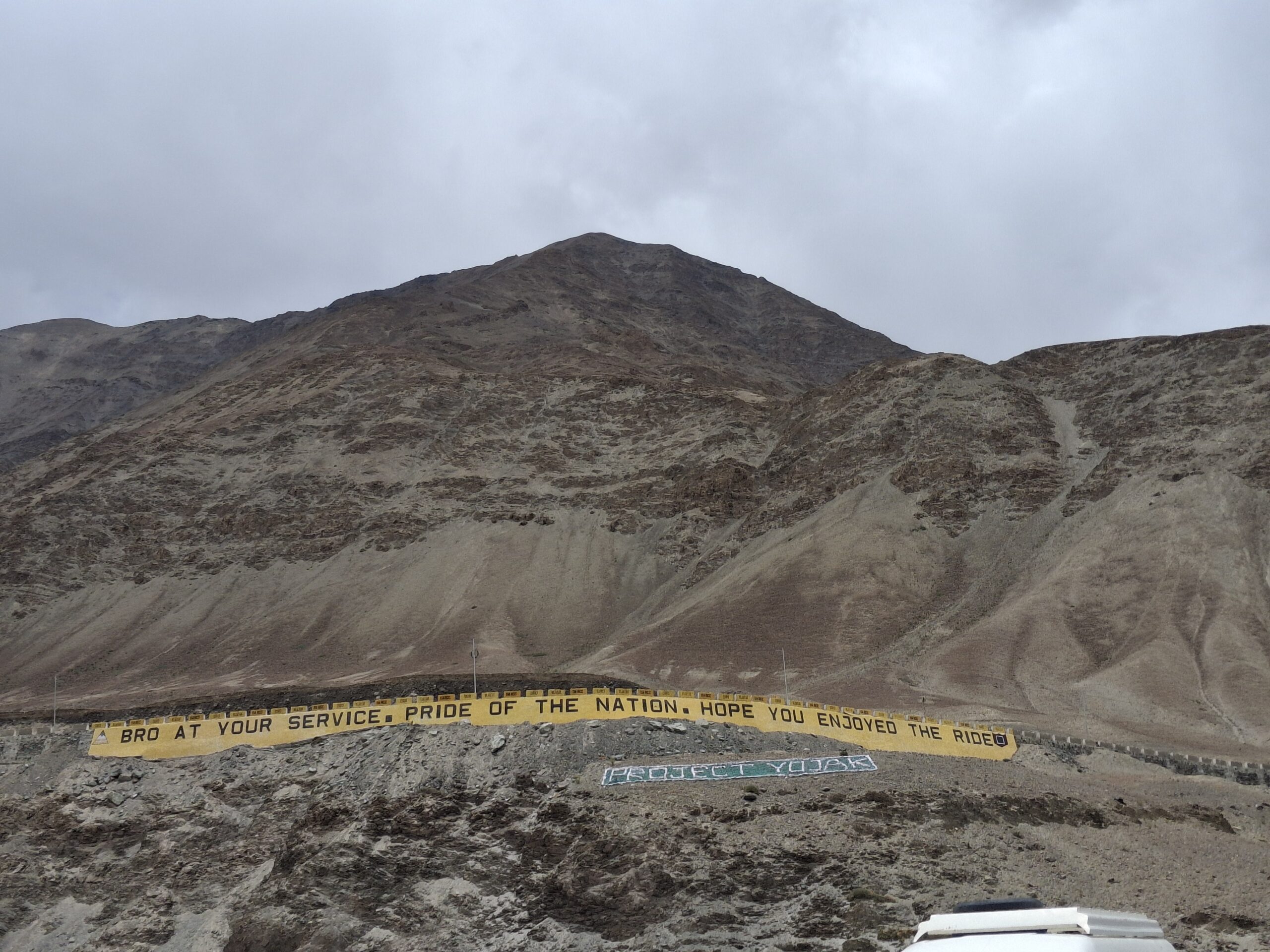
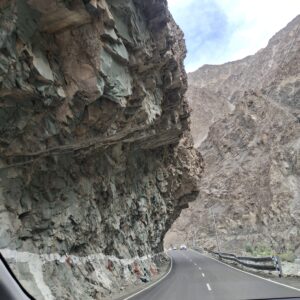
From Srinagar, as we drove along the Srinagar–Leh highway, we could not miss multiple signboards, slogans, and references to BRO. BRO stands for the Border Roads Organisation, an entity formed as early as 1960, exclusively to conceive, develop, build, and maintain road infrastructure along India’s border areas. One cannot help but wonder at the quality of the highways in these tough terrains, often built by cutting and drilling through complex Rocky Mountains. It must be noted that the annual budget allocated to BRO over the last 10 years, since this government took over, is roughly Rs 5,900 crores, compared to Rs 2,250 crores in the previous 10 years – a whopping 160% increase. This is clearly reflected in the quality of the roads, except for some patches, prompting the wife to suggest that even the development and maintenance of roads in Mumbai should be handed over to the BRO! Jokes apart, the kind of focus this government has put on developing road infrastructure up close to the borders is certainly commendable. Considering the fact that roads have been made carving out of mountains, maintaining them so well is also commendable.
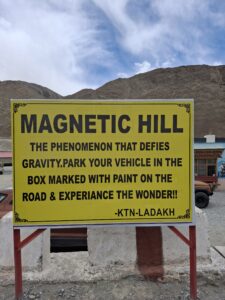
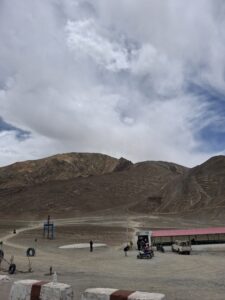
From the Sangam point, we went to Magnetic Hill, famous for its optical illusion. There is a white box painted on the road at a point where, if you turn off your engine and put your car in neutral, the vehicle will appear to roll “uphill” on its own. This is what we were told. But we didn’t see any such optical illusion. What we saw was that this place has become a hub for hiring bikes and biking along the beautiful highway, with the mountains providing a surreal backdrop. This is also an ATV (All-Terrain Vehicle) rental spot where you can explore rough terrain. The beautiful road, with the mountains and a clear blue sky as a backdrop, makes this stretch an ideal place for bikers to capture curated pictures and videos.
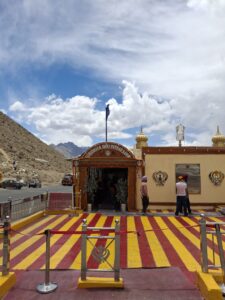
There is also a Gurudwara, Gurudwara Pathar Sahib, on the way back to Leh town, which was our next stop. This Gurudwara is entirely maintained by the Indian Army. The shrine got its name because it is built around a huge boulder (pathar).
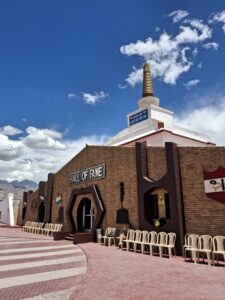
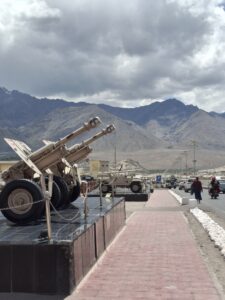
On our way back to Leh town, adjacent to the Leh airport and the airbase, is the Hall of Fame, an army museum. This museum has been built in memory of the soldiers who lost their lives in the Indo-Pak wars. The army also runs a nice restaurant-cum-souvenir shop called Aroma, close by, where they serve predominantly South Indian vegetarian fare. UPI has become so ubiquitous that they accept only digital payments here. This is a recurring theme throughout our visit, even in the remotest places, near the borders, and at high altitudes. You can pay through UPI without having to look for cash.
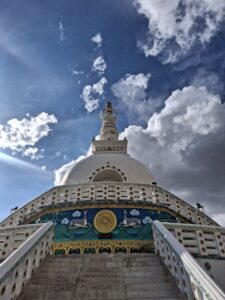
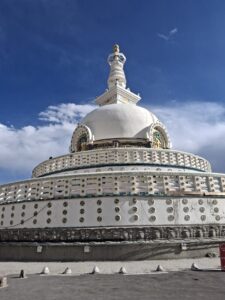
After a short break, our next stop was the famous and beautiful Shanti Stupa, a white-domed Buddhist stupa in Leh. It was built in 1991 by the Buddhist monk Gyomyo Nakamura, who is of Japanese origin. Today, the monument is an important tourist attraction for its religious significance and its elevated location, which offers a 360-degree panoramic view of Leh.
Our local tour of Leh ended in the evening, not before spending some time in the local market. The market street is quite organised, with shops, cafes and restaurants dotting both sides of the road. Now, for the other Dhurandhar reference I was talking about. Those who have watched Dhurandhar would recall the Tea Shop scene in Lyari, where Ranveer, as Hamza, meets Aalam Bhai, played by Gaurav Gera. The tea shop, Washma Butt Biryani and Tea Shop, is located near the main market area in Leh. Originally called the S.H. Khan restaurant, it has now become so famous that the owners have even retained the filmy name Washma Butt! This has become a popular spot among Instagrammers, who come here to shoot reels of themselves sipping tea.
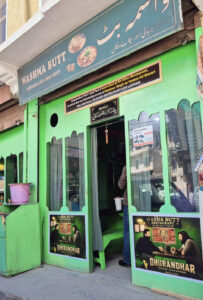
Films have always been effective vehicles for increasing a place’s visibility and promoting tourism. If Dhurandhar helped promote a few spots in the Leh area, there is another whole place in Ladakh that owes its immense popularity and traffic to another iconic film. More about that in the coming parts.
To be continued…
Part 3: Read here
Part 4 and Final: Read here
Excellent Anand. I get to see Indus through your photos. This district colours of two rivers is also seen at Triveni Sangam of Ganges, Yamuna and one other. Also I have see similar at Koblenz in Germany. Lovely write up
Thanks, Suri. Thanks also adding your bit of info. Appreciate it.
Superb post Anand with photographs and videos. Am
tempted to visit the place. I am 79 years and wife 73 years old. Will we comfortable to undertake this tour?
Liked your post. You are spot on on description.
Wishing well.
Neelakantan
Thanks for your feedback, Sir. Yes, you will be able to travel up to Leh without much problem. For safety sake, please consult your regular Dr before travel. Acclimatisation is important for 2 days.
We visited in 2021 and seems to be lot of improvement.Your description is marvelous,and I could visualise all things as picture perfect.kardungla and pangon lake is still fresh in memory.
Thanks Venkat. Appreciate your comments. WIll cover those places in the next part.
Pingback: Altitude Matters: My Journey through Ladakh – Part 1
Pingback: Altitude Matters: My Journey through Ladakh – Part 3